

Understand restricted stock units (RSUs), community property, vesting, and the time-rule formulas California courts may use.
Restricted stock units, or RSUs, often represent one of the most valuable assets in a California divorce. Unlike a bank account or a piece of real estate, RSUs tie directly to employment, vest over time, and may not convert into actual shares until months or years after separation. This timing matters because California generally treats property acquired during marriage as community property, while compensation earned after separation becomes separate property. (See Cal. Family Code §§ 760, 770, 771 for statutory explanations of community and separate property).
What Are RSUs?
Employers promise RSUs as company shares to be delivered in the future if you meet certain conditions, most often continued employment through a vesting date. Unlike stock options, RSUs typically do not require you to pay an exercise price; once they vest, you receive shares or their cash equivalent, subject to tax withholding and plan rules. RSUs serve as deferred compensation, not a simple asset that you can always divide immediately.
Are RSUs Community Property?
In California, the law does not automatically treat RSUs as separate property just because they vest after separation. The key issue is when and why you earned the RSUs. If you received a grant during marriage, it may contain a community component even if it remains unvested on the date of separation, because California courts often treat contingent or deferred employment compensation as divisible property to the extent you earned it during the marriage. Usually, parties determine the community share by applying a formula to calculate the community’s interest from the employee spouse’s separate property interest. During a dissolution or legal separation, parties typically hire an expert to calculate the separate and community property interests using one of the two formulas described below.
The Date of Separation Matters
In both formulas described below, you need the date of separation to calculate the community and separate property interests in the RSUs. If your RSUs were granted before separation but they vest afterward, the court may allocate only the portion you earned before separation to the marital estate. Even a change of a few months in the separation date can materially alter the community percentage, especially for grants with annual or multi-year vesting schedules. For this reason, gather grant notices, vesting schedules, employment agreements, plan documents, and pay records as early as possible in the case.
The Hug and Nelson Formulas
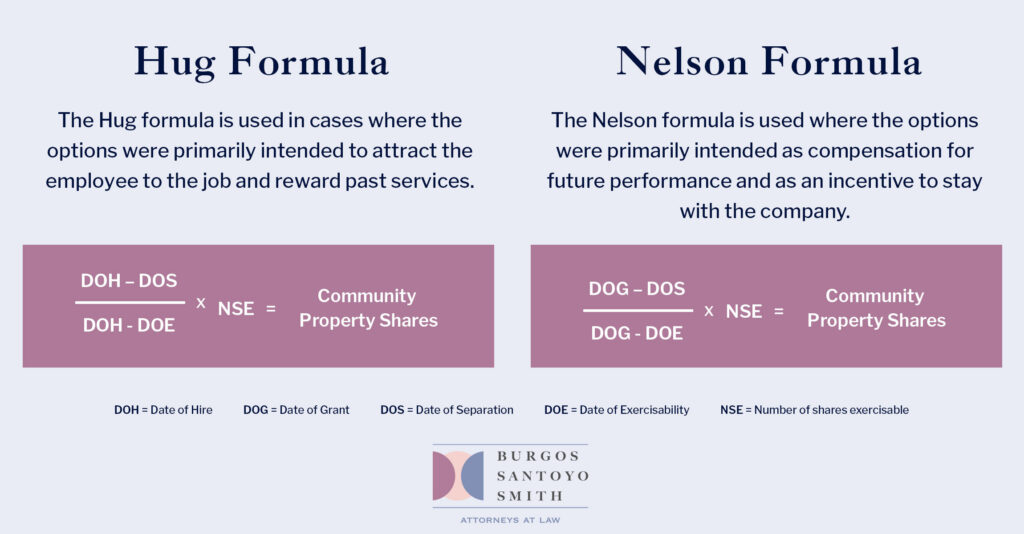
California courts typically utilize two formulas associated with Marriage of Hug or Marriage of Nelson. (Marriage of Hug, (1984) 154 Cal.App.3d 780; Marriage of Nelson, (1986) 177 Cal.App.3d 150.)
Courts use the Hug formula for RSUs granted primarily to reward past service. They use the Nelson formula for RSUs granted primarily to incentivize future performance or encourage the employee to stay; in some cases, another formula may fit better. The court’s characterization depends on the evidence, including employer communications, offer letters, compensation history, and the timing of the award.
It is important to note that just because these formulas are often used, the court has discretion to deviate from these formulas to obtain an equitable allocation of the RSUs.
How RSUs May Be Divided in Practice
Once you identify the community portion, spouses must decide how to divide it. Some settlements offset the non-employee spouse’s interest with other property, such as cash, home equity, or retirement assets. Others take a “wait and see” approach, where the non-employee spouse receives their share only if and when the RSUs actually vest. Because many equity plans restrict transfers to a former spouse, you need carefully drafted orders to address notice, sale timing, tax withholding, and what happens if the employee leaves the company before vesting. The best structure depends on the plan documents, the parties’ liquidity, and their tolerance for future contact. Make sure you work with an attorney knowledgeable in RSU division to ensure the order or agreement is enforceable.
Tax Issues Should Not Be an Afterthought
RSUs are generally taxed as ordinary income when they vest, and employers often withhold shares or cash to cover payroll and income taxes. A divorce settlement should specify whether the non-employee spouse receives a gross share count or a net-after-tax share, who bears withholding, how future tax reporting will be handled, and whether the employee spouse must provide vesting and sale records. Without clear language, one spouse may unintentionally absorb more of the tax burden than intended. Tax treatment can also affect valuation when one spouse is buying out the other’s interest.
Practical Tips for Divorcing Spouses
- If you are the employee spouse, collect every RSU grant notice, vesting schedule, plan document, employment agreement, and stock-plan portal statement and prepare to disclose this information to your non-employee spouse.
- Determine the grant date, vesting dates, number of units, and whether the award was for past performance, retention, or future incentive.
- Identify which grants were made before marriage, during marriage, after separation, and after divorce filing.
- Consider whether a forensic accountant or Certified Divorce Financial Analyst should model different division outcomes.
- Draft settlement terms that address taxes, vesting notices, sale timing, employment termination, and record sharing.
RSUs in a California divorce require more than simply looking at whose name appears on the stock account. The court or the parties must determine when the RSUs were earned, why they were granted, what portion belongs to the community, and how taxes and vesting mechanics will be handled. Because the outcome can depend heavily on the facts and the governing equity plan, anyone dealing with RSUs in divorce should obtain advice from a qualified California family law attorney and, when appropriate, a financial or tax professional.
We Are Here to Help
If you need guidance on dividing restricted stock units in your California divorce or have questions about how the rules in this article apply to your situation, Burgos Santoyo Smith is here for you. Our experienced team provides compassionate, knowledgeable support at every stage. We are committed to helping you navigate the complexities of RSU division and move forward with confidence. Call us at (833) 931-1615 or fill out our online consultation form.
Key Takeaways for Dividing RSUs in a California Divorce:
- RSUs can be one of the most valuable and complex assets to divide in a California divorce.
- The timing of RSU grants and vesting is crucial; California usually treats property acquired during marriage as community property, while post-separation compensation is often separate property.
- Courts use formulas (Hug or Nelson) to determine the community and separate property interests in RSUs, depending on why the RSUs were awarded.
- The date of separation can significantly impact the division, so gather all grant notices, vesting schedules, and related documents early.
- Settlement terms should address how to divide RSUs, including tax treatment, vesting, sale timing, and record sharing.
- Work with experienced legal and financial professionals to ensure the RSU division is enforceable and equitable.